Category: Company Press Release

  • The future of the European Transformer industry in the age of AI: The next decade

    The future of the European Transformer industry in the age of AI: The next decade

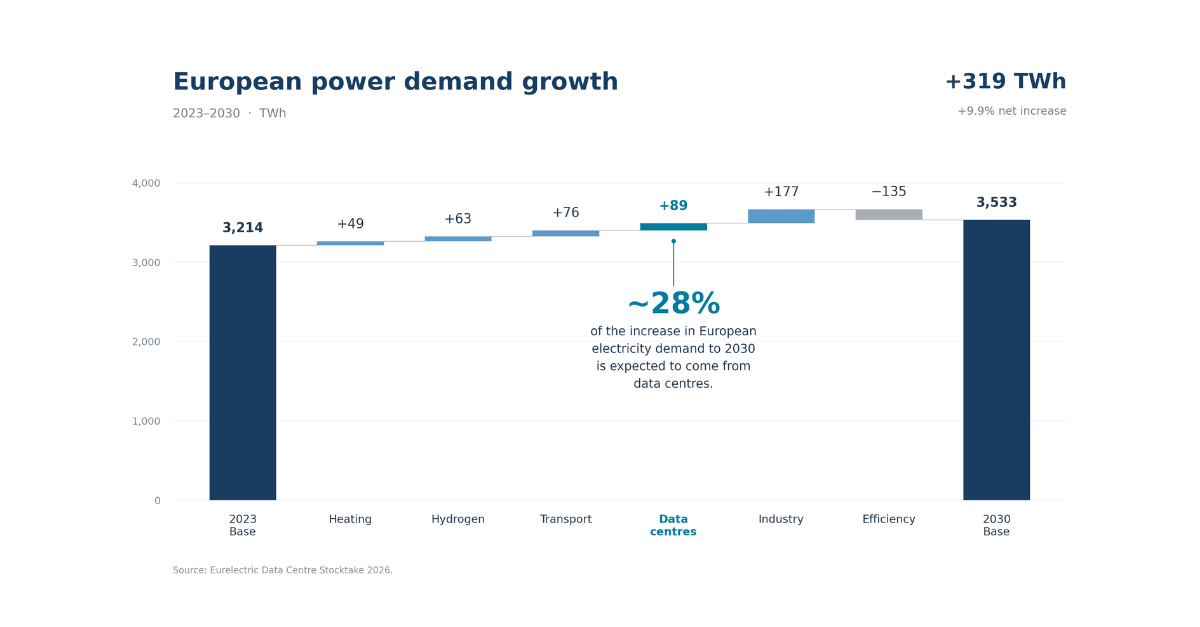
    For much of the past decade, the electricity demand in major European economies remained relatively stable– until the rise of artificial intelligence (AI). The rapid development of artificial intelligence has introduced a significant new source of electricity demand: data centres.

    Global data centres will double electricity consumption by 2030, while electricity consumption from AI-focused data centres is expected to triple over the same period. The booming of data centers is the most fast-paced, denser, fastest-growing new utility demand that happened in a generation. Now, how it gets connected to the grid – how clean energy sourcing and energy efficiency are built into that connection from the very beginning – will shape Europe’s next round of energy market investments.

    At the centre of this transformation is an essential piece of electrical equipment: the transformer.

    The European energy market context:

    The European energy industry hasn’t seen such a dramatic leap in over a decade. Driven largely by electrification and renewables, AI data centres and artificial intelligence (AI) have now become a substantial new customer of the energy sector. AI is both creating new electricity demand and providing tools to manage increasingly complex energy systems. The challenge is ensuring that physical electricity infrastructure can develop at a pace that supports these technological changes.

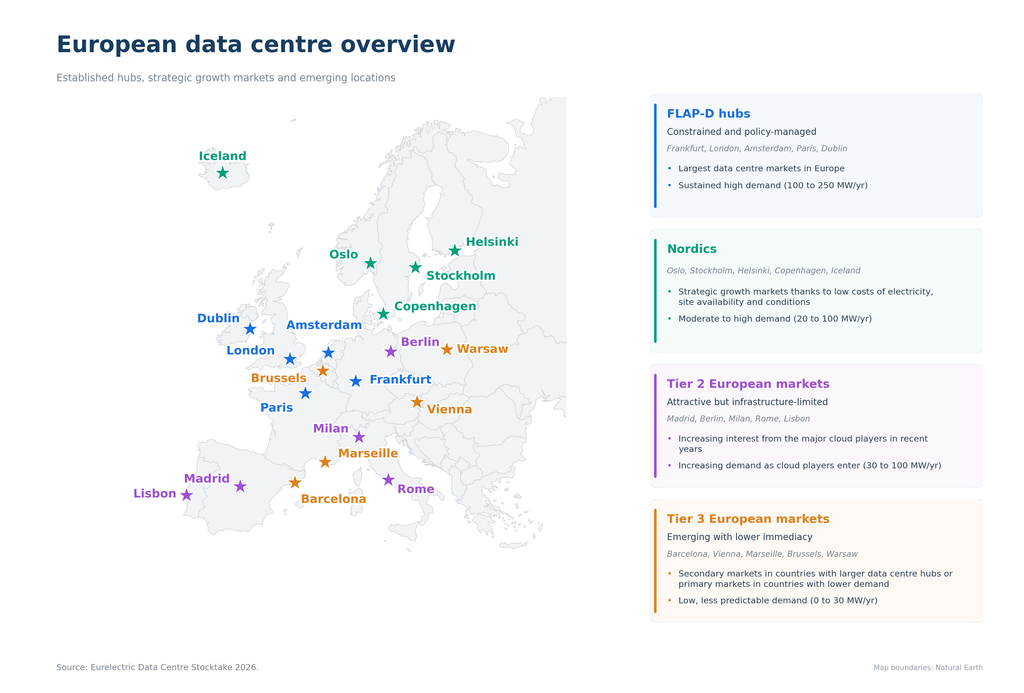
    Growth is now spilling into European regions, including the Nordics – where natural cool temperatures, availability of land, and clean power sources are attracting investment on their own. Finland, for example, is emerging as a potential location for additional data-centre infrastructure. Its established electricity system, energy expertise, and access to low-carbon power create opportunities for investment, although grid availability and project permitting remain important considerations.
    However, increasing electricity production alone will not solve Europe’s energy challenges. According to the European Commission, approximately 40% of the EU’s electricity distribution grids are more than 40 years old. Grid Action Plan identified an estimated €584 billion in investment needs to modernize and expand electricity infrastructure towards 2030. Source: European Commission, European Grids

    These investments are essential for connecting renewable energy installations, reinforcing transmission and distribution systems, and supporting the changing geographical distribution of electricity demand. The decisions taken today will eventually shape Europe’s energy future for the next decade.

    What does this mean for Europe’s transformer industry — specifically?

    As electricity demand increases and grid infrastructure becomes more complex, so must the transformer industry. The boom in demand for energy infrastructure has placed the traditional transformer industry at the centre of an emerging bottleneck: production capacity and supply chain constraints.

    As Europe races to meet the rising electricity demand, it requires additional transformers across different voltage levels and applications. The transformer industry involves a complex network of specialized suppliers. Copper, electrical steel, insulation materials, mechanical components, and machined parts must all meet demanding technical requirements. A shortage or delay at any stage can affect the whole production schedule. Supply chains are being reshaped by capacity shortages, geopolitical risk, localisation policies and the need for delivery reliability.

    The European Network of Transmission System Operators for Electricity (ENTSO-E) identified plans for 2,820 new power transformers among participating transmission system operators between 2026 and 2035, in addition to their existing fleet of 5,649 units. Source: ENTSO-E, Transmission Grid Investment and Supply Chain Assessment, November 2026

    Particularly large power transformers can face severe constraints due to limited manufacturing capacity, complex structure and extended lead time up to four years, according to IEA’s 2025 analysis. The challenge is ensuring the availability of transformers, components, and other grid-supporting equipment to connect with the new data centers and power infrastructure fast enough.

    What does 2026–2030 look like?

    For Buyers and suppliers, this window demands mutual collaboration and procurement discipline.

    Quality suppliers across tiers. Timely delivery of finished units largely depends on suppliers’ delivery reliability and quality. Strengthening long-term supplier partnerships is crucial for this.

    Improve communication across the supply chain. Better demand forecasting, shared production plans, and schedules can reduce uncertainty and help to identify potential bottlenecks before they affect delivery.

    For suppliers, this window is a structural growth opportunity. Companies positioned with product quality proven against international benchmarks and delivery speed will beat the market.

    How does Finvacon come into play?

    As demand for electrical infrastructure grows, transformers are being designed for higher voltages, increased efficiency, and faster project delivery schedules. These developments place even greater demands on transformer insulation component manufacturing.

    Finvacon specializes in manufacturing customized transformer insulation and metal components for European energy industry market leaders. Success depends on getting the fundamentals right: high-quality raw materials according to European transformer manufacturer standards, precision machining, strict quality control, and dependable delivery. As part of the transformer supply chain, we continue to invest in our inventory, manufacturing capacity, and delivery reliability to support the changing needs of the European energy industry.

    References:

    IEA, Key Questions on Energy and AI, April 2026

    European Commission, European Grids

    ENTSO-E, Transmission Grid Investment and Supply Chain Assessment, November 2026

    IEA, Building the Future Transmission Grid, February 2025

    Frequently Asked Questions

    How will artificial intelligence affect transformer demand in Europe?

    AI-driven data-centre development is creating additional electricity demand and increasing the need for grid connections and power distribution infrastructure. Combined with electrification and renewable energy investments, this is expected to support demand for transformers across different voltage levels.

    Why are transformer supply chains important for Europe’s energy transition?

    Transformer production depends on specialized materials and components, including electrical steel, copper, and insulation materials. Limited manufacturing capacity or component shortages can delay transformer deliveries and, consequently, electricity infrastructure projects.

    What is Finvacon’s role in transformer manufacturing?

    Finvacon is a Finland-based component supplier for transformer insulation and metal parts. The company specializes in precision machining, gluing, and assembly of components made from KP wood, pressboard, and other composite materials according to transformer manufacturers’ technical requirements.
  • Transformer Insulation Materials and Components Explained: KP Wood, Laminated Pressboard, and Aramid Boards

    Transformer Insulation Materials and Components Explained: KP Wood, Laminated Pressboard, and Aramid Boards

    As the transformer industry continues to evolve, so do its electrical insulation needs. For transformer manufacturers across Europe, sourcing the right insulation raw materials and components means meeting exact technical requirements consistently, while maintaining reliable production and delivery accuracy.

    In this article, three important materials used for transformer insulation have been explained: transformer wood (KP wood), laminated pressboard, and aramid boards. Each material offers different electrical, mechanical, and thermal properties for specific transformer applications. Finvacon specializes in machining these materials into precision insulation components according to customer drawings and requirements.

    Transformer Wood — KP Wood

    Transformer wood, widely known as KP wood, is one of the technically demanding materials used in the transformer supply chain. It is a densified beech wood engineered for applications in oil-immersed transformers. KP wood is used for clamping structures, pressure beams, support brackets, and other load-bearing components that help hold the transformer core and winding assembly firmly in place.

    Its combination of high compressive strength, oil compatibility, and controlled dielectric properties makes KP wood well suited for transformer insulation and structural applications. It can offer large dimensions, very low moisture absorption, fast oil absorption, and can withstand high voltage under oil, depending on the material specification and application. Finvacon stocks and machines KP wood in various dimensions and veneer qualities, including SQ and HQ, ready to be machined according to customers’ specific drawings.

    Laminated Pressboard

    Manufactured from refined cellulose fibres under high pressure, laminated pressboard is widely used as an electrical insulation material in oil-immersed transformers. When impregnated with transformer oil, it provides the required dielectric performance while also offering mechanical support within the insulation system. Laminated pressboard can take many forms and serve different functions inside a transformer. It is used for barriers between windings, strips and spacers for oil passage and cooling, pressboard rings between winding layers, and other insulation structures designed for specific transformer applications.

    Finvacon stocks laminated pressboard in various weights, dimensions, and thicknesses suitable for transformer applications across the European market. At our machining facilities, standard plates are converted into finished insulation components such as barriers, strips, rings, and profiled parts, precisely machined according to customer drawings while optimizing material use.

    Aramid Insulation Materials

    Aramid board materials are used in transformer insulation applications where high thermal stability and mechanical performance are required.

    Compared with conventional cellulose-based insulation materials, aramid board materials can offer higher temperature resistance and maintain their mechanical properties at temperatures where traditional materials begin to degrade. Their thermal performance also makes them suitable for transformer designs requiring higher operating temperatures, compact construction, or increased overload capacity. Finvacon has experience in machining aramid board insulation materials into customized transformer components according to customer requirements and technical drawings.

    Finvacon — Transformer Insulation Component Supplier for Europe

    Finvacon is a Finland-based supplier of precision-machined transformer insulation components for the European transformer industry. By combining access to quality insulation raw materials with advanced CNC machining capabilities, we manufacture components from KP wood, laminated pressboard, aramid boards, and other insulation materials according to customer specifications. Our technical team supports customers with raw materials, component development, prototyping, and machining to achieve accurate components with minimal material waste and keep the price competitive. This allows transformer manufacturers to source both insulation materials and precision-machined components from a single supplier.

    Supporting Europe’s Energy Transition

    The demand for transformers is increasing as European electricity grids expand and adapt to renewable energy generation, electrification, and growing energy demand. As a supplier of precision-machined transformer insulation components, Finvacon continues to invest in material availability, machining capacity, and technical capabilities to support the changing needs of the European transformer industry.

  • Finvacon proves profitability and social responsibility can go hand in hand

    Finvacon proves profitability and social responsibility can go hand in hand

    Despite the recent global economic turmoil, Finvacon Ltd has found a solid niche in the highly specialized B2B market. Manufacturing insulation and metal components for transformers, Finvacon operates as a subcontractor for some of the world’s largest producers of transformers and electric motors. The company counts industry giants such as Hitachi Energy, Siemens Energy, and ABB among its key clients. 

    According to CEO Kaj Sundén, the partnership with Hitachi Energy has been an important learning experience for the company.  

    “Hitachi’s strict quality requirements in areas such as delivery reliability and quality control have pushed us to enhance our capabilities”, he explains. 

    A unique history regarding social responsibility differentiates the company from many of its peers. Operations began in 1969 as a workshop, offering job opportunities for people with disabilities. Although the business has grown and expanded over the past decades, nearly half of the company’s employees still represent groups that otherwise may have difficulties finding employment. 

    What may seem as a remarkable concept to most, Finvacon simply views it as the way things should be done.  

    “It is just a part of our everyday business, just as it should be for a lot of other companies as well”, Sundén says, hoping to one day export this mindset to Europe. 

    Read the full article here: https://www.coastline.fi/finvacon-proves-profitability-and-social-responsibility-can-go-hand-in-hand/

  • Diversity and inclusion are in our DNA

    Diversity and inclusion are in our DNA

    At Finvacon, it doesn’t matter what language you speak, where you come from, or what challenges you face. Here, diversity and inclusion are a given. Iryna Bakalchuk and Gabriela Miranda have just had lunch at their workplace, Finvacon. Iryna Bakalchuk started working there in October 2022, about six months after she came to Vaasa from the war in Ukraine.

    Gabriela Miranda is from São Paulo, Brazil. She has lived in Finland for 16 years. She first lived in Helsinki. Three years ago she moved to Vaasa to study. Last year she did an internship at Finvacon and now has a permanent job as a CNC machinist.

    “For us it’s completely natural, it’s in our DNA”, says Kaj Sundén, CEO of Finvacon. At Finvacon you don’t need to know Finnish, Swedish or even English to get a job. Kaj Sundén hopes that more companies will think the same way. The most important thing is not what language you know, but that you feel safe at work and that you trust each other and feel a sense of community.

    We don’t think much about who works here. But people from outside have said that it’s a wonderful environment here, very different compared to other companies in the Vaasa region. Others notice things that we ourselves may not see.

    “Courage” is one of Finvacon’s slogans, “new normal” is another – diversity should be a natural and obvious part of working life. The company wants to be a role model for others.

    Read the full article here: https://www.vasabladet.fi/Artikel/Visa/887573?shareID=Mkw5ajRGQnlKVU94dm0vL2VtcDBxdz09

  • Why Standards Matter in Transformer Wood Insulation Components

    Why Standards Matter in Transformer Wood Insulation Components

    When discussing transformer performance and reliability, attention often focuses on major components such as the core, windings, or tank. Yet some of the most critical elements are the electric insulation components that support the transformer’s internal structure and ensure long-term operational stability. Among these materials, KP wood and other compressed wood insulation materials play a vital role in oil-filled transformers. These components are responsible for maintaining mechanical strength, supporting clamping structures, and preserving insulation integrity throughout the transformer’s service life, which may exceed 30 years.

    KP wood insulation components are widely used inside power transformers due to their excellent electrical and mechanical strength, various dimensional ranges, and compatibility with transformer oil. They are commonly machined into spacers, support blocks, rings, pressure elements, and customized structural parts that help secure the active part of the transformer.

    The Critical Role of KP Wood in Oil-filled Transformers

    Although these components may appear simple, they operate under demanding conditions. During short-circuit events, transformers can experience significant mechanical forces. Insulation components must withstand these stresses while maintaining their structural integrity and precise dimensions.

    Even minor dimensional deviations can affect clamping pressure, assembly accuracy, and long-term transformer performance.

    Why Material Standards are Essential

    The quality requirements for transformer wood insulation components extend far beyond appearance or basic machining accuracy.

    High-quality transformer insulation materials must offer:

    • Consistent density and mechanical strength
    • Reliable compatibility with transformer oil
    • Low moisture content
    • Long-term dimensional stability
    • Resistance to aging and degradation

    Non-compliant materials can introduce moisture, particles, or chemical contaminants into the insulation system. These issues may remain undetected for years while gradually reducing transformer reliability and lifespan. For transformer manufacturers, utilities, and grid operators, component quality directly impacts operational security and lifecycle costs.

    Precision Machining: Where Quality Becomes Performance

    Raw material quality is only one part of the equation. Precision machining determines whether insulation components perform as intended inside the transformer.

    At Finvacon, we specialize in machining customized transformer insulation components according to customer-specific drawings and technical requirements. Our focus is on achieving the highest possible dimensional accuracy ensuring small details, reliable gluing performance, and quickest possible delivery accuracy.

    • Long-term expertise in wood process industry
    • Wide range of wood insulation components for oil-filled transformers
    • Raw materials compliant with IEC standards and fast delivery
    • Wide stock of wood insulation materials of various dimensions
    • Dimensions and tolerances as per customer drawings
    • In-depth knowledge of transformer wood materials and deep understanding of complex components’ structure
    • Long-term partnership with transformer market leaders in Europe

    Supporting Europe’s Leading Transformer Manufacturers

    Finvacon serves some of Europe’s leading transformer manufacturers and energy technology companies. Our insulation components are used in applications where quality requirements are exceptionally high and non-conformances are simply not acceptable. We maintain a carefully managed inventory of market-approved insulation materials, enabling efficient production and reliable deliveries. Combined with technical expertise, precision machining, and responsive customer support, this allows us to help our customers meet demanding project schedules and quality targets. Our experience includes supplying insulation components for projects serving utilities, grid operators, renewable energy infrastructure, and industrial power systems across Europe.

    The Future of Transformer Insulation Manufacturing

    As the energy sector continues to evolve, transformers are being designed for higher voltages, increased efficiency, and faster project delivery schedules. These developments place even greater demands on insulation materials and component manufacturing. Success depends on getting the fundamentals right: high-quality materials, precision machining, strict quality control, and close collaboration with customers. At Finvacon, we believe that reliable transformer performance begins with reliable insulation components. By combining trusted transformer insulation materials with customized machining solutions, we help transformer manufacturers build equipment that performs safely and reliably for decades.

  • Finvacon will attend CWIEME Berlin 2026

    Finvacon will attend CWIEME Berlin 2026

    We are attending CWIEME Berlin 2026, 19-21 May. Register now to get your free ticket to CWIEME Berlin 2026 Exhibition – the world’s leading exhibition for transformers, electric motors, and e-mobility.

    Find us at CWIEME Berlin 2026, Hall HUB 27, Booth 27F10, to learn more about our premium-quality products for your sustainable energy needs, showcasing our expertise in transformer insulation and metal components. Our team will be showcasing expertise in transformer wood and a wide range of high-performance raw materials used in core production, winding, and assembly.

    Discover our unique service for transformer insulation made of transformer wood and other high-performance insulation materials, pressboards (PSP), laminated pressboards (HDLC/HDLP), and aramid boards. Register Here

  • Finvacon will attend Coiltech Deutschland 2026

    Finvacon will attend Coiltech Deutschland 2026

    We are attending Coiltech Deutschland 2026. Register now to get your free ticket to the Coiltech Deutschland 2026 Exhibition – the Capital of Coil Winding.

    Find us at booth 3-C17, from 25-26 March at Messe Augsburg (Exhibition Centre) – Am Messezentrum 5, 86159 Augsburg, Germany. Come to meet us and learn more about our premium-quality products for your sustainable energy needs. Our team will be present there for 2 days to showcase our expertise in transformer insulation and metal components.

    Discover our unique service for transformer insulation components made of transformer wood and other high-performance insulation materials, such as pressboards (PSP), laminated pressboard (HDLP/HDLC), and aramid boards.

    Register here for free – Register Here

    When: March 25-26, 2026

    Where: Messe Augsburg (Exhibition Centre) – Am Messezentrum 5, 86159 Augsburg, Germany

  • Finvacon Joins X-Culture Global Business Week 2025

    Finvacon Joins X-Culture Global Business Week 2025

    A group of 200 students, faculty members from different universities and X-culture team members visited Finvacon as part of the X-Culture Global Business Week 2025, held from August 3–9. The event was co-organized by the University of Vaasa and X-Culture, an international experimental learning project that involves 150 universities from 70 countries to exchange cultural experience through solving real-life business challenges. Participants worked in groups on company-specific tasks, and the event concluded with a Gala award ceremony following all presentations.

    This international event brings students, academia and businesses together to co-create solutions in the field of clean energy, innovation, climate action and sustainable industries through meaningful collaboration.

    After evaluating solutions presented by 7 different groups for Finvacon challenge, one group was selected for their practical business thinking and innovative solutions.

    Thanks to the X-Culture team and co-organizer University of Vaasa for creating such an amazing experience to inspire and motivate us to continue our work on sustainability and green energy revolution.

  • Finvacon has transferred its laundry business

    Finvacon has transferred its laundry business

    Finvacon has transferred its laundry services to Eco-Wash. From now on Pesula is no more a part Finvacon’s business. The pesula services will run its operations at Eco-Wash at Kokkokalliontie 10, 65300 Vaasa.

  • We have officially moved!

    We have officially moved!

    We’ve recently taken a big step in expanding our business from two facilities to three.

    Our metal production, including our Head office, has moved from Gneissinkuja to a larger, more modern facility in Runsor, Vaasa. The electric insulation production will remain in Strömberg Park, close to our assembly operations.

    This relocation was crucial for the future since it provides more space and smarter facilities for our machines and procedures. Additionally, this move was essential for the growth we’ve experienced recently.

    As you can see, we’ve spread out quite a bit. However, Finvacon’s core values, excellence in quality, and zero-fault principle remain the same.