
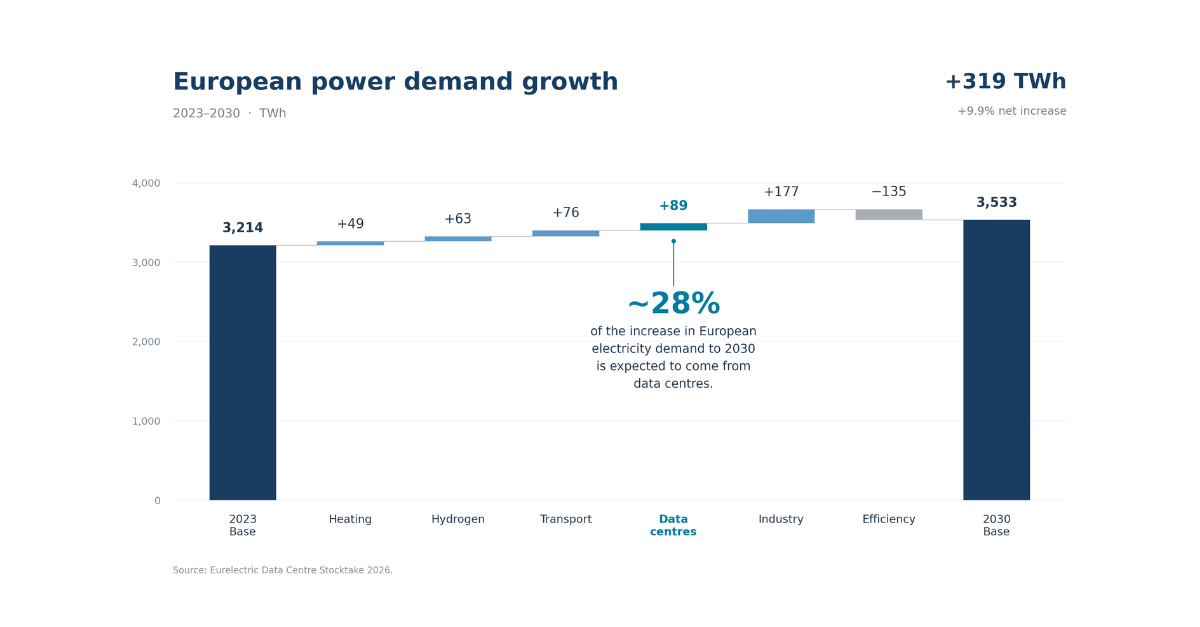
For much of the past decade, the electricity demand in major European economies remained relatively stable– until the rise of artificial intelligence (AI). The rapid development of artificial intelligence has introduced a significant new source of electricity demand: data centres.
Global data centres will double electricity consumption by 2030, while electricity consumption from AI-focused data centres is expected to triple over the same period. The booming of data centers is the most fast-paced, denser, fastest-growing new utility demand that happened in a generation. Now, how it gets connected to the grid – how clean energy sourcing and energy efficiency are built into that connection from the very beginning – will shape Europe’s next round of energy market investments.
At the centre of this transformation is an essential piece of electrical equipment: the transformer.
The European energy market context:
The European energy industry hasn’t seen such a dramatic leap in over a decade. Driven largely by electrification and renewables, AI data centres and artificial intelligence (AI) have now become a substantial new customer of the energy sector. AI is both creating new electricity demand and providing tools to manage increasingly complex energy systems. The challenge is ensuring that physical electricity infrastructure can develop at a pace that supports these technological changes.
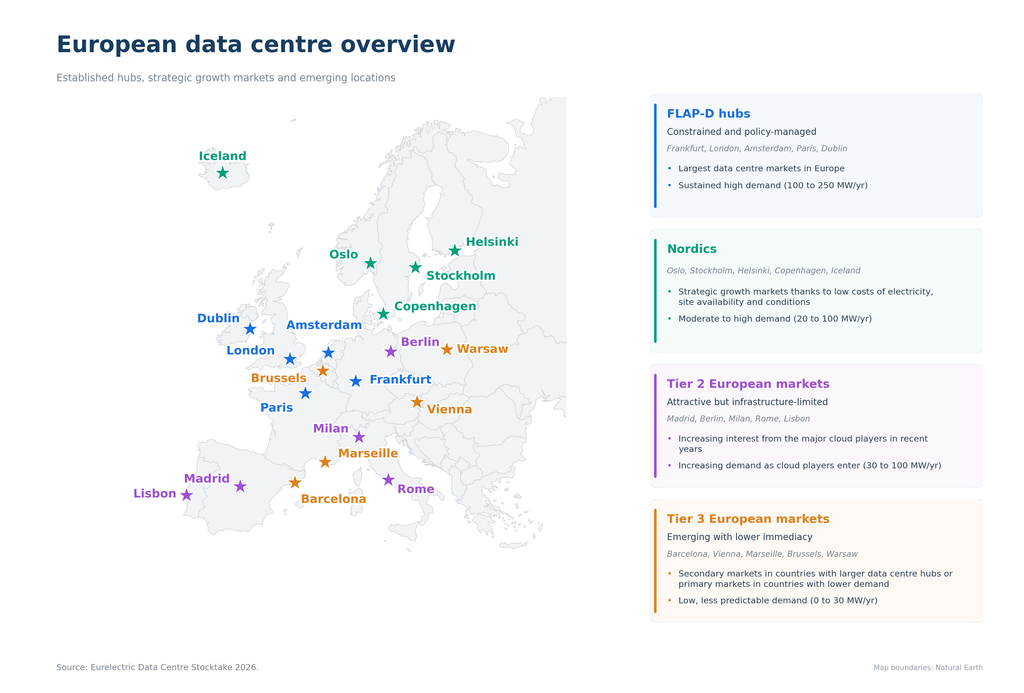
Growth is now spilling into European regions, including the Nordics – where natural cool temperatures, availability of land, and clean power sources are attracting investment on their own. Finland, for example, is emerging as a potential location for additional data-centre infrastructure. Its established electricity system, energy expertise, and access to low-carbon power create opportunities for investment, although grid availability and project permitting remain important considerations.
However, increasing electricity production alone will not solve Europe’s energy challenges. According to the European Commission, approximately 40% of the EU’s electricity distribution grids are more than 40 years old. Grid Action Plan identified an estimated €584 billion in investment needs to modernize and expand electricity infrastructure towards 2030. Source: European Commission, European Grids
These investments are essential for connecting renewable energy installations, reinforcing transmission and distribution systems, and supporting the changing geographical distribution of electricity demand. The decisions taken today will eventually shape Europe’s energy future for the next decade.
What does this mean for Europe’s transformer industry — specifically?
As electricity demand increases and grid infrastructure becomes more complex, so must the transformer industry. The boom in demand for energy infrastructure has placed the traditional transformer industry at the centre of an emerging bottleneck: production capacity and supply chain constraints.
As Europe races to meet the rising electricity demand, it requires additional transformers across different voltage levels and applications. The transformer industry involves a complex network of specialized suppliers. Copper, electrical steel, insulation materials, mechanical components, and machined parts must all meet demanding technical requirements. A shortage or delay at any stage can affect the whole production schedule. Supply chains are being reshaped by capacity shortages, geopolitical risk, localisation policies and the need for delivery reliability.
The European Network of Transmission System Operators for Electricity (ENTSO-E) identified plans for 2,820 new power transformers among participating transmission system operators between 2026 and 2035, in addition to their existing fleet of 5,649 units. Source: ENTSO-E, Transmission Grid Investment and Supply Chain Assessment, November 2026
Particularly large power transformers can face severe constraints due to limited manufacturing capacity, complex structure and extended lead time up to four years, according to IEA’s 2025 analysis. The challenge is ensuring the availability of transformers, components, and other grid-supporting equipment to connect with the new data centers and power infrastructure fast enough.
What does 2026–2030 look like?
For Buyers and suppliers, this window demands mutual collaboration and procurement discipline.
Quality suppliers across tiers. Timely delivery of finished units largely depends on suppliers’ delivery reliability and quality. Strengthening long-term supplier partnerships is crucial for this.
Improve communication across the supply chain. Better demand forecasting, shared production plans, and schedules can reduce uncertainty and help to identify potential bottlenecks before they affect delivery.
For suppliers, this window is a structural growth opportunity. Companies positioned with product quality proven against international benchmarks and delivery speed will beat the market.
How does Finvacon come into play?
As demand for electrical infrastructure grows, transformers are being designed for higher voltages, increased efficiency, and faster project delivery schedules. These developments place even greater demands on transformer insulation component manufacturing.
Finvacon specializes in manufacturing customized transformer insulation and metal components for European energy industry market leaders. Success depends on getting the fundamentals right: high-quality raw materials according to European transformer manufacturer standards, precision machining, strict quality control, and dependable delivery. As part of the transformer supply chain, we continue to invest in our inventory, manufacturing capacity, and delivery reliability to support the changing needs of the European energy industry.
References:
IEA, Key Questions on Energy and AI, April 2026
European Commission, European Grids
ENTSO-E, Transmission Grid Investment and Supply Chain Assessment, November 2026
IEA, Building the Future Transmission Grid, February 2025
Frequently Asked Questions
How will artificial intelligence affect transformer demand in Europe?
AI-driven data-centre development is creating additional electricity demand and increasing the need for grid connections and power distribution infrastructure. Combined with electrification and renewable energy investments, this is expected to support demand for transformers across different voltage levels.
Why are transformer supply chains important for Europe’s energy transition?
Transformer production depends on specialized materials and components, including electrical steel, copper, and insulation materials. Limited manufacturing capacity or component shortages can delay transformer deliveries and, consequently, electricity infrastructure projects.
What is Finvacon’s role in transformer manufacturing?
Finvacon is a Finland-based component supplier for transformer insulation and metal parts. The company specializes in precision machining, gluing, and assembly of components made from KP wood, pressboard, and other composite materials according to transformer manufacturers’ technical requirements.